
Twelve questions to settle before white-label delivery
The terms that protect an agency's client relationship, and the ones most often left vague.
- Author
- Orivion editorial
- Published
- Last reviewed
- Reading time
- 5 min
Written from Orivion's delivery practice.
Why this matters
White-label partnerships fail on ambiguity more than on skill. When visibility, ownership and escalation are unclear, small issues become client-facing problems.
How to evaluate a partner before committing a client project
Start with a bounded brief that includes the deliverable, acceptance criteria, timeline and who reviews it. Ask how the partner will demonstrate fit and confirm capacity. Review a representative deliverable or agree a paid discovery scope; do not infer production readiness from a sales presentation.
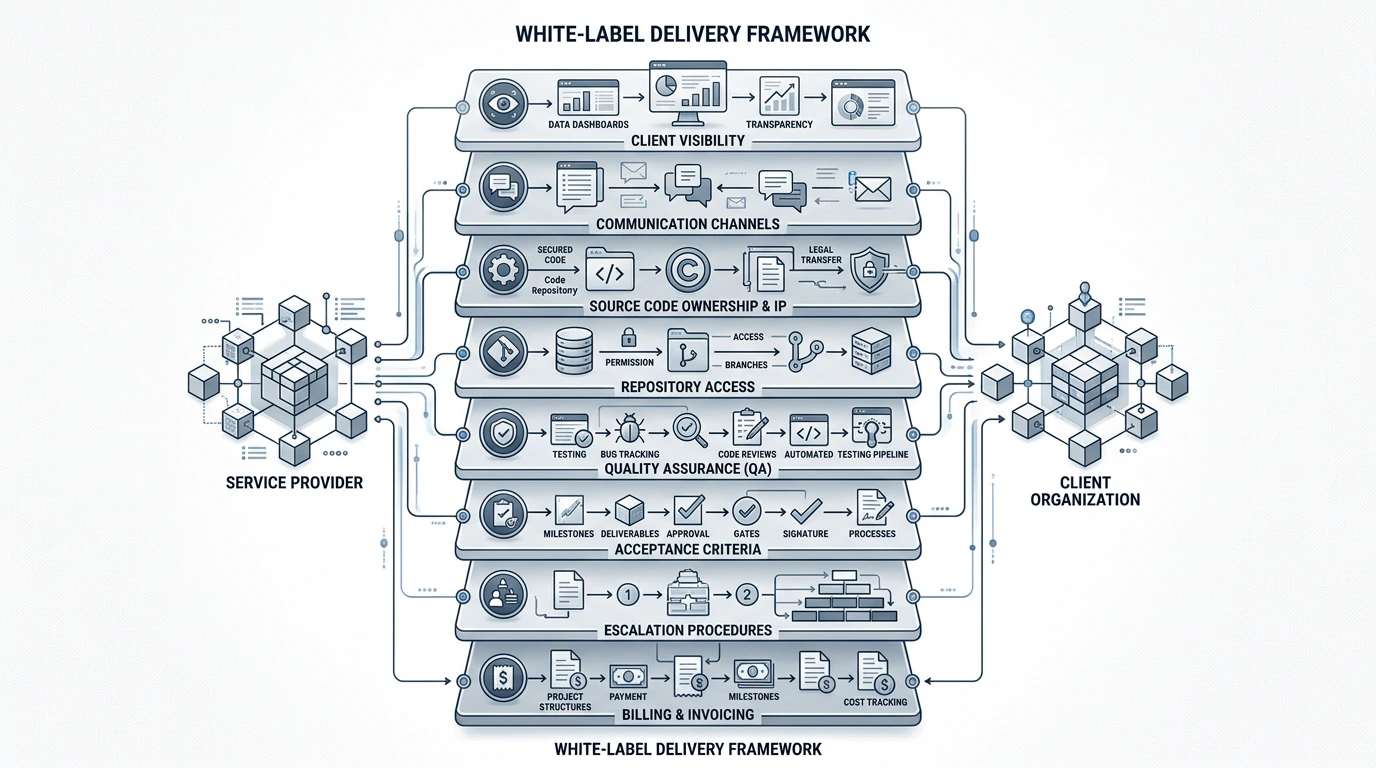
Write a responsibility matrix for discovery, design, engineering, testing, client communication and release approval. Your agency and the delivery partner should each know who decides, who does the work and who accepts it. Agree how scope changes and blocked dependencies affect cost and timing.
At handover, check repository and account access, build and deployment instructions, design assets, known issues and the support arrangement. Confirm that the ownership and confidentiality terms match the client commitments your agency has made.
Relationship and visibility
Decide whether the partner is invisible, introduced as part of your team, or named. Each option needs its own communication rules: who speaks to the client, through which channels and with which identity.
Ownership and access
Agree who owns deliverables and source code, when rights transfer, and whether work happens in your repositories and accounts or is transferred at handover.
Quality and escalation
Replace vague promises with a defined QA and acceptance process: acceptance criteria per deliverable, internal testing, your review, and a named escalation route with response times.
Settle these in writing
- NDA and non-solicitation
- IP and source-code ownership
- Repository and tool access
- Client visibility
- Communication rules
- Project management ownership
- Escalation route
- Acceptance criteria
- QA process
- Documentation standard
- Capacity planning
- Billing model
What to do next
Use the list as an agenda for the first conversation with any delivery partner, including us.
Information on this site is general. It is not legal, tax or financial advice. Requirements change, so confirm current rules with the relevant authority or a licensed adviser.
Want to talk through how this applies to your business?