
Industries / Retail & E-commerce
Unified commerce: one view of products, stock, orders and customers.
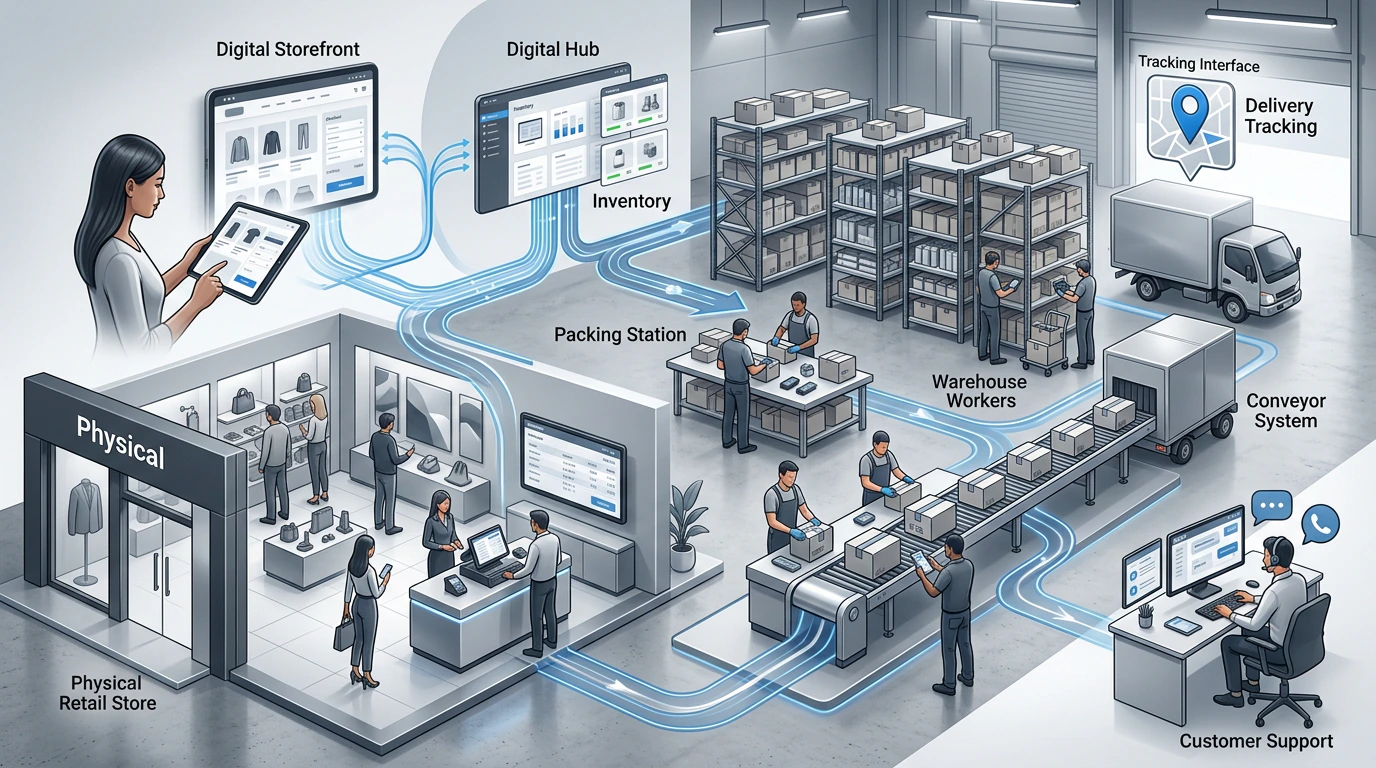
Retail growth now means more channels: a store, marketplaces, social commerce, wholesale and physical locations. Each one adds orders, stock movements and customer records. We connect them into one commerce system so customers see accurate availability, teams stop re-keying, and marketing can use consented customer data properly.
Industry challenge
What makes this sector different.
Channels multiply faster than the systems that keep stock, orders and customers consistent.
- 01
Inconsistent stock
Availability that differs between channels and the warehouse.
- 02
Fragmented customer data
Customers known separately by the store, marketplace and point of sale.
- 03
Manual operations
Orders, returns and invoices handled by hand as volumes grow.
- 04
Margin blind spots
Revenue visible, contribution by product and channel unclear.
Digital opportunities
Where digital work pays off.
Unified commerce
Central catalogue, stock and order management across channels.
Customer profiles
One consented customer record for service and marketing.
Fulfilment automation
Orders routed to the right location with status updates to customers.
Lifecycle marketing
Segmented email and messaging based on real purchase behaviour.
Example architecture
Example architecture
A reference pattern for multichannel retail: every channel on one side, the operational systems on the other, with order and customer data at the centre.
- Online store
- Marketplaces
- Point of sale
- Social
- Email & WhatsApp
- Product data
- Inventory
- Fulfilment
- Accounting
- Analytics
Reference pattern
A connected retail & e-commerce stack, not a client system.
Channels customers use on one side, operational systems on the other, connected through a governed core. The exact components depend on what you already run.
Use cases
What Orivion builds in this sector.
Store plus marketplaces
Shopify connected to Amazon and Noon with shared stock and one order flow.
Returns without spreadsheets
Self-service returns with automatic refunds, restocking and reporting.
Loyalty and retention
Purchase-based segments and campaigns tied to customer profiles.
Contribution reporting
Margin by product, channel and campaign in one dashboard.
Common workflows
Journeys we connect end to end.
Order to delivery
- 01Order
- 02Payment
- 03Allocation
- 04Pick & pack
- 05Ship
- 06Deliver
Returns
- 01Request
- 02Approval
- 03Collection
- 04Inspection
- 05Refund
- 06Restock
Relevant services
Capabilities that apply here.
- GrowCommerce & Digital OperationsThe commerce system end to end.
- RunCRM, Sales & Customer SystemsCustomer profiles and service.
- GrowDigital Marketing & GrowthAcquisition and lifecycle marketing.
- GrowSocial, Content & MediaProduct content and social commerce.
- RunData & Business IntelligenceSales, margin and customer analytics.
Context
Data and consent context
Personalisation depends on customer data, and customer data depends on consent. We design consent capture and preference management into checkout and CRM so marketing stays both effective and lawful.
Payments are handled by PCI DSS compliant providers, and eInvoicing obligations in the UAE should be considered when designing order-to-invoice flows.
Information on this site is general. It is not legal, tax or financial advice. Requirements change, so confirm current rules with the relevant authority or a licensed adviser.
Proof
How we would approach it.
Capability demonstrations show how Orivion would approach a problem. They are not client projects and carry no client results.
FAQ
Questions buyers ask
Can you connect our physical stores and online store?
Yes, where the point-of-sale system supports integration. Shared stock and customer profiles are usually the first goals.
Which platform should we use?
It depends on catalogue, channels, B2B needs and team. Shopify suits most retailers; WooCommerce and headless options suit specific needs.
Can you help with marketplaces like Noon and Amazon?
Yes, including listing management, stock sync and order routing.
Insights
Further reading.
- UAE Market Entry6 min readUAE eInvoicing: what changes, when, and what to check nowMandatory electronic invoicing arrives in phases from 2027. It is a data and systems project as much as a compliance one.Read
- Data5 min readBefore the dashboard: can the business trust its numbers?Dashboards fail when definitions and data quality are left for later. Start underneath.Read
Working on a retail & e-commerce challenge? Tell us what needs to change.