
Grow / Commerce & Digital Operations
The storefront is only one part of the commerce system.
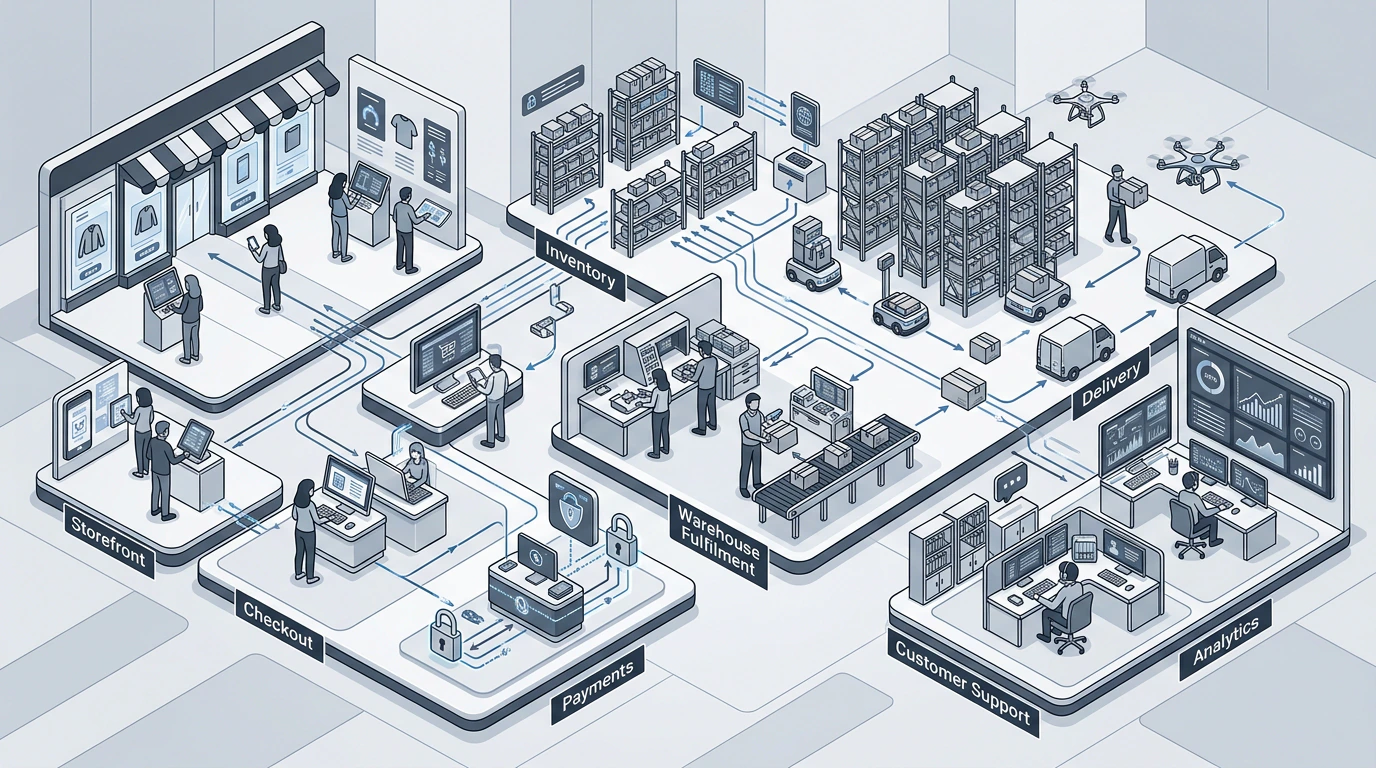
A good-looking store with manual order handling, inaccurate stock and disconnected customer data is a problem waiting for growth to expose it. We design and build commerce as an operating system: product data, storefront, checkout, payments, orders, inventory, fulfilment, returns, CRM and analytics connected end to end.
The problem
Where commerce operations break
Growth multiplies every manual step behind the storefront.
- Orders re-keyed into accounting or warehouse systems
- Stock that differs between the website, marketplaces and the warehouse
- Product data maintained in several places
- Returns handled by email and spreadsheet
- Customer data trapped in the store platform
- Marketplace listings managed separately from the main catalogue
- No clear view of margin by product, channel or campaign
Why it matters
Why it matters
Customers judge the whole experience: accurate availability, a checkout that works, delivery that arrives when promised, and returns that are easy. Most of that happens behind the storefront.
Connecting product, customer, order and inventory data is what makes personalisation, accurate reporting and multichannel selling possible. Without it, every new channel adds work instead of revenue.
The commerce system
From product to analytics, every step connected.
Each step hands clean data to the next. That is what lets a business add channels without adding chaos.
01Product
02Catalogue
03Storefront
04Customer
05Checkout
06Payment
07Order
08Inventory
09Fulfilment
10Returns
11CRM
12Analytics
Capabilities
What Orivion can deliver.
Storefront, catalogue, checkout, orders, inventory and fulfilment working as one system.
Platforms
- Shopify and Shopify Plus
- WooCommerce
- Custom ecommerce
- Headless commerce
- B2B commerce
- Subscription commerce
Product systems
- Catalogue structure
- Product data and enrichment
- Pricing
- Promotions
- PIM
Checkout and payments
- Checkout architecture
- Payment gateways
- Local and international payment methods
- Fraud controls
Marketplaces
- Amazon
- Noon
- Other marketplace integrations
- Central listing management
Operations
- Inventory
- Order management (OMS)
- Fulfilment and shipping
- Warehouse integration
- Returns
Integrations
- ERP
- Accounting
- CRM
- Analytics and reporting
Use cases
What clients hire this for.
Representative problems this service is used to solve.
Launch a store with operations ready
Build the storefront together with payments, shipping, stock sync and accounting, so day one does not start with manual work.
Sell on marketplaces from one catalogue
Manage listings, prices and stock centrally and route marketplace orders into the same fulfilment flow.
B2B ordering portal
Give trade customers account pricing, quick ordering, credit terms and order history.
Automate order to invoice
Send orders to the warehouse and accounting automatically, with exceptions flagged for review.
Understand margin by channel
Combine sales, cost, shipping and marketing data to report contribution by product and channel.
Methodology
How a commerce programme is delivered
The model and data come first, the storefront follows, and optimisation never really ends.
01
Commerce model
What you sell, to whom, through which channels, and how it is fulfilled.
02
Product data
Structure, attributes, media and ownership of product information.
03
Customer journey
Discovery, product pages, cart, checkout and post-purchase.
04
Platform
Choose and configure the platform for the model and scale.
05
Checkout
Payments, taxes, shipping options and fraud controls.
06
Operations
Inventory, orders, fulfilment and returns processes.
07
Integrations
ERP, accounting, warehouse, CRM and marketplaces.
08
Analytics
Ecommerce tracking and reporting on sales, margin and customers.
09
Launch
Staged go-live with order monitoring.
10
Continuous optimisation
Conversion, average order value and operational efficiency.
Deliverables
What you receive.
The exact set depends on scope. These are typical for an engagement of this kind.
- Commerce model and system architecture
- Configured store and theme or headless front end
- Product data model and import
- Payment and shipping configuration
- Integrations with ERP, accounting, CRM and marketplaces
- Order and returns workflows
- Ecommerce analytics and dashboards
- Operating documentation and training
Technology
Platforms chosen for the problem.
Platforms selected for catalogue size, channel mix, integration needs and team skills:
Commerce
- Shopify
- Shopify Plus
- WooCommerce
- Headless storefronts
Marketplaces
- Amazon
- Noon
Payments
- Stripe
- Checkout.com
- Network International
- Tabby and Tamara where suited
Operations
- ERP including Odoo
- Accounting platforms
- Shipping and 3PL integrations
Security and governance
Payments and customer data handled carefully
Commerce touches money and personal data, so controls are part of the build.
Payment security
Payments handled by PCI DSS compliant providers, keeping card data out of your systems.
Consent
Marketing consent and preferences recorded at checkout and respected downstream.
Operational controls
Order, refund and stock adjustments logged with user and reason.
Engagement models
How this is usually delivered.
Delivered as a managed project for the build and integrations, followed by an optimisation retainer or dedicated support. Available white-label to agencies.
Proof
How we would approach it.
Capability demonstrations show how Orivion would approach a problem. They are not client projects and carry no client results.
Case studies are published only with client approval and verified results. Until then, our capability demonstrations show how we approach problems like this one.
See capability demonstrationsRelated capabilities
Services that usually connect to this one.
- BuildWeb, Apps & Digital ProductsWebsites, portals, web and mobile applications built to perform after launch.
- RunCRM, Sales & Customer SystemsThe customer journey from first enquiry to retention, connected in one system.
- GrowDigital Marketing & GrowthSearch, paid media, lifecycle and conversion, measured against customer value.
- RunData & Business IntelligenceData pipelines, trusted metrics, dashboards and analytics the whole business can rely on.
FAQ
Questions buyers ask
Shopify or WooCommerce?
Shopify suits most businesses that want reliability with less maintenance. WooCommerce suits teams already invested in WordPress who need deep customisation. Headless makes sense for complex content or multi-brand needs. We recommend based on your model and resources.
Can you connect our store to our accounting or ERP system?
Yes, using native connectors where they are reliable and custom integrations where they are not, with monitoring for failed syncs.
Do you handle Amazon and Noon?
Yes. We integrate marketplaces with your central catalogue, stock and order flow so they do not run as separate businesses.
Will eInvoicing affect our store?
In the UAE, mandatory eInvoicing is being introduced in phases from 2027. Commerce businesses should review how invoice data flows from the store to accounting and whether their systems can produce compliant invoices through an Accredited Service Provider.
What happens after launch?
Commerce is never finished. We agree an optimisation plan covering conversion, performance, catalogue and operational improvements.
Selling online or planning to? Let us map your commerce system first.