
Guide
Mainland or free zone? Start with how the business needs to operate.
Compare mainland and free zone company setup against your activities, customers, premises, ownership and visa plan. There is no universally better route for a UAE founder or an overseas business expanding here; the useful question is which permissions and operating requirements apply to yours.
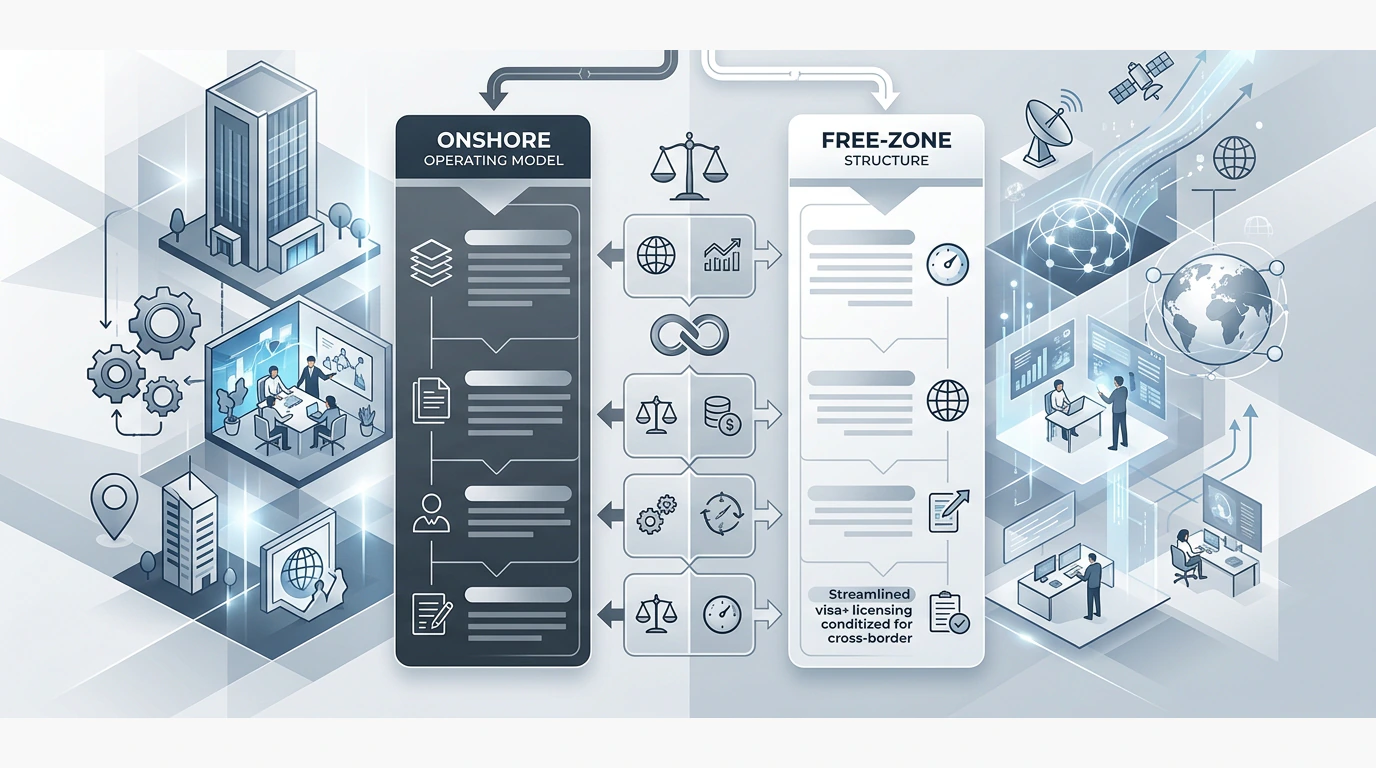
Factor by factor
What to check, not who wins.
Each row sets out how the mainland and free zones typically treat a factor, and the question that decides it for your business.
| Factor | Mainland | Free zone | What decides it |
|---|---|---|---|
| Business activities | Licensed against the emirate's activity list. Some activities need sector approval. | Each authority has its own activity list. Not every activity is available everywhere. | Confirm the exact activity is available, and whether it needs approval. |
| Customer geography | Direct trade across the UAE market, subject to the activity. | Whether a free zone company can serve customers or carry out activities outside its free zone depends on the activity, the jurisdiction and the applicable licensing and permit framework. | Where you will invoice, and whether you will serve UAE consumers directly. |
| Physical premises | Premises and a registered tenancy contract are commonly required. | Many licences include a flexi-desk; offices are available. | Whether the activity, customers or visa plan need real premises. |
| Ownership | Foreign investors can fully own onshore companies across many activities. Activities of strategic impact are defined by the Cabinet and carry additional ownership and licensing controls, so ownership must be confirmed for the specific activity. | Generally full foreign ownership under each free zone's rules. | Whether the specific activity carries ownership controls. |
| Visa requirements | Quota usually linked to premises. | Allocation set by the package or the workspace. | How many visas you need now and in two years. |
| Office or warehouse | Wide choice of commercial and industrial premises. | Varies by authority; some have dedicated warehouse and industrial zones. | Whether you will hold stock, produce or store goods. |
| External approvals | Applied for alongside the licence where needed. | Also apply in free zones for regulated activities. | Which regulator, if any, must approve the activity. |
| Expansion | Branches in other emirates are possible. | Expansion outside the zone follows the permission framework that applies. | Where you expect to operate in two to three years. |
| Authority | The emirate's economic department, such as DET in Dubai. | The free zone authority. | Who you will deal with for renewals and amendments. |
| Cost structure | Built from activity, premises, approvals and visas; quoted per setup. | Often a published package, plus visas and extras. | First-year cost including visas, premises and approvals, not the headline price. |
| Renewal structure | Licence and premises renew on their own terms. | Package renewal, sometimes published, plus visa-related renewals. | Year-two cost, and which first-year items are one-time. |
FAQ
Questions we are asked
Can a free zone company work with mainland clients?
Whether a free zone company can serve customers or carry out activities outside its free zone depends on the activity, the jurisdiction and the applicable licensing and permit framework. In Dubai, qualifying free zone establishments have routes to carry out activities outside their free zone through DET licences or permits, subject to the applicable conditions. Selling services to mainland businesses, selling goods, and operating from premises outside the zone are treated differently, so we check your specific model.
Is a free zone always cheaper?
No. Published free zone packages can have a lower headline price, but visas, premises, approvals and renewals often change the comparison. Compare first-year and renewal costs for your scenario.
Is the mainland always better for UAE customers?
No. Many service businesses serving UAE clients operate from free zones within their permissions. Physical customer-facing premises and certain activities are where the mainland is usually the route to evaluate first.
Ready to compare authorities? See the Free Zone Comparison.
See which structures fit your business.
Answer seven questions and compare routes with published authority costs.