
Build / Software Engineering & Cloud
Software designed around the operation it needs to support.
Orivion delivers custom software development, system integration and cloud engineering from Dubai for UAE and international teams. Off-the-shelf software covers the common case. Custom software earns its cost where your process is specific, where systems need to talk to each other, or where existing applications have stopped scaling. We engineer applications, APIs and cloud platforms around how the business actually works, then keep them observable and maintainable.
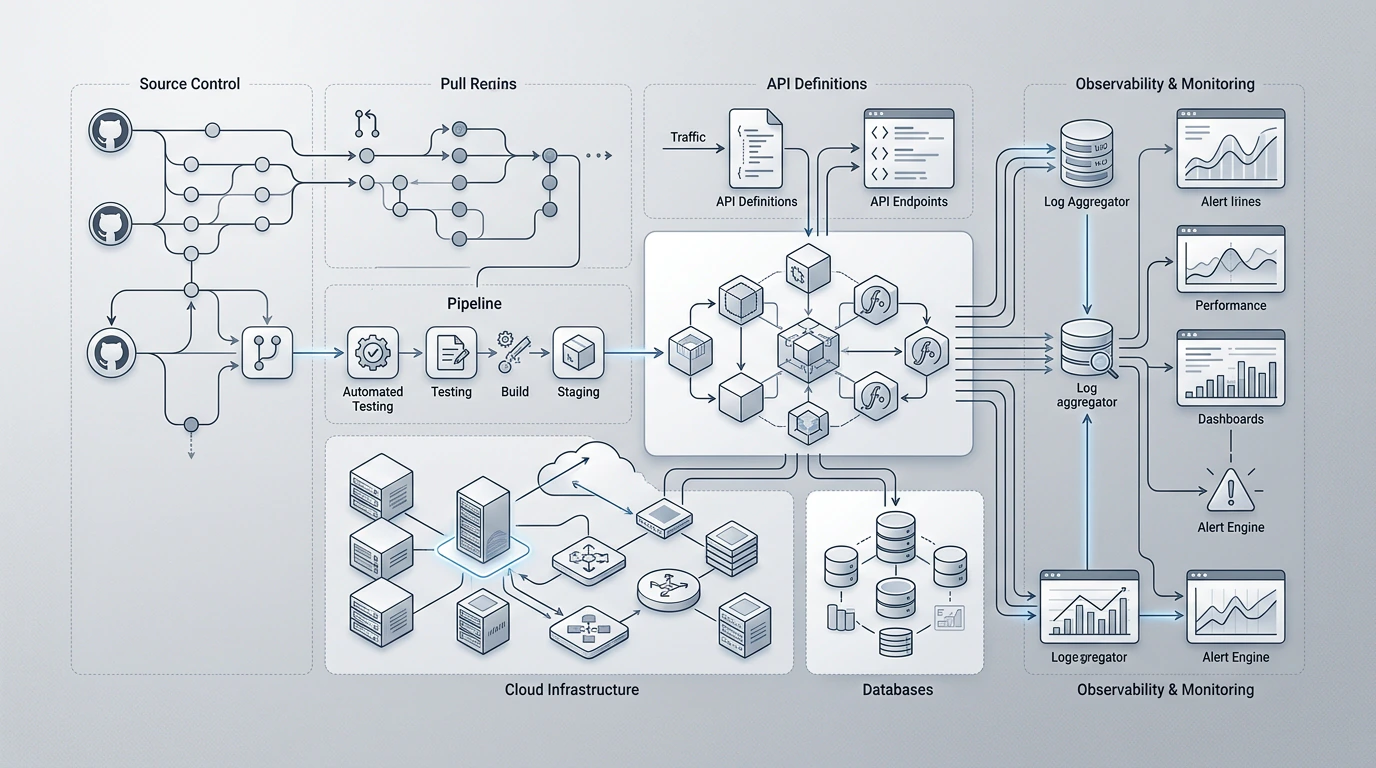
The problem
The operational symptoms of a software problem
Software problems rarely announce themselves as software problems. They show up as operational friction.
- Systems that do not share data, so people copy it between screens
- Critical workflows running on spreadsheets and email
- Legacy applications that only one person understands
- Performance that degrades as users or data grow
- Integrations that fail silently and are discovered by customers
- Databases without clear ownership, backups or structure
- Releases that need a weekend and a lot of courage
- No monitoring, so problems are found late
- Security weaknesses in authentication, access control or dependencies
Why it matters
Why it matters
Software sets the ceiling on how fast an operation can move. When systems are disconnected or fragile, every new product, market or customer adds manual work and risk instead of revenue.
Good engineering is measured by how safely and frequently a team can change the system, how quickly problems are detected, and what the platform costs to run. We treat architecture, testing, deployment and observability as part of the product, because they decide whether the software stays useful after the first release.
Capabilities
What Orivion can deliver.
Custom applications, APIs, integrations, cloud and DevOps designed around your operation.
Application engineering
- Custom business applications
- Backend services
- Internal systems
- Enterprise applications
- SaaS products
APIs and integration
- REST and GraphQL APIs
- Integration services
- Webhook architecture
- API gateways
- Third-party and ERP integration, including Odoo where appropriate
Architecture
- Database design
- Authentication and authorisation
- Event-driven and distributed systems
- Microservices where the complexity is justified
- Serverless architecture
Cloud
- AWS
- Microsoft Azure
- Google Cloud Platform
- Cloudflare
- Containerised deployments
DevOps and reliability
- CI/CD pipelines
- Infrastructure as code
- Observability, logging and alerting
- Backups and recovery
- Cost monitoring
Quality engineering
- Unit and integration testing
- End-to-end testing
- Performance testing
- Regression suites
- Code review standards
Modernisation
- Legacy application modernisation
- Cloud migration
- Database migration
- Monolith decomposition where it pays off
Use cases
What clients hire this for.
Representative problems this service is used to solve.
Replace a spreadsheet-run operation
Model the process, data and roles, then build an application with approvals, audit history and reporting that the team can rely on.
Connect sales, finance and operations
Build an integration layer so orders, invoices and customer records move between systems automatically, with errors surfaced rather than lost.
Give a legacy application a future
Stabilise, add tests and monitoring, then migrate module by module to a maintainable architecture without stopping the business.
Launch a SaaS product
Design a multi-tenant architecture with authentication, billing hooks, admin tooling and a release pipeline built for frequent change.
Move to the cloud with control
Plan the migration, set up environments, pipelines and monitoring, and put cost and access controls in place from day one.
Expose data through a secure API
Offer partners or mobile apps a documented, versioned API with proper authentication, rate limits and logging.
Methodology
How software is engineered here
Architecture decisions are made early and explicitly, then validated with working software rather than slideware.
01
Business process
Map the operation the software must support, including exceptions, not just the happy path.
02
Requirements
Functional and non-functional requirements: volumes, response times, security, availability and compliance.
03
Solution architecture
Components, data model, integrations, hosting and the trade-offs behind each choice, documented.
04
Prototype
The riskiest workflow or integration built first, to prove the approach before scaling it.
05
Build
Short increments with code review, automated tests and a demo at the end of each cycle.
06
Integrate
Connect to the systems around it, with contracts, retries and error handling.
07
Test
Automated suites plus user acceptance testing against agreed criteria.
08
Deploy
Automated, repeatable releases with rollback.
09
Observe
Logs, metrics, alerts and dashboards so problems are seen before users report them.
10
Iterate
A prioritised backlog and regular releases, with technical debt managed deliberately.
Deliverables
What you receive.
The exact set depends on scope. These are typical for an engagement of this kind.
- Architecture and decision records
- Source code with automated tests, in your repository
- API documentation
- Infrastructure as code and environment configuration
- CI/CD pipelines
- Monitoring dashboards and alert rules
- Runbooks for operation and recovery
- Security and access model documentation
- Handover and knowledge transfer sessions
Technology
Platforms chosen for the problem.
Chosen for the problem, the team that will maintain it and the cost of running it. Common tools include:
Languages
- TypeScript
- Node.js
- Python
- Go
- C# / .NET
Data
- PostgreSQL
- MySQL
- SQL Server
- Redis
- MongoDB where suited
Cloud
- AWS
- Azure
- Google Cloud
- Cloudflare Workers
Delivery
- GitHub Actions
- Docker
- Kubernetes where justified
- Terraform
Observability
- OpenTelemetry
- Grafana
- Sentry
- Cloud-native monitoring
Security and governance
Security and reliability by design
Controls are designed with the system, then verified before and after release.
Access control
Role-based access, least privilege, and authentication using established standards such as OAuth 2.0 and OpenID Connect.
Secure delivery
Dependency scanning, secrets management and reviewed changes through the pipeline.
Data protection
Encryption in transit and at rest, backups tested by restoring them, and data kept in agreed regions.
Operational readiness
Alerting, runbooks and a clear incident route agreed before go-live.
Engagement models
How this is usually delivered.
Delivered as a managed project, by a dedicated engineering team for longer programmes, or through embedded project specialists where you lead the roadmap. Available white-label to agencies and consultancies.
Proof
How we would approach it.
Capability demonstrations show how Orivion would approach a problem. They are not client projects and carry no client results.
Related capabilities
Services that usually connect to this one.
- BuildWeb, Apps & Digital ProductsWebsites, portals, web and mobile applications built to perform after launch.
- RunAI & AutomationWorkflow automation, document processing, AI assistants and agents, with controls built in.
- RunData & Business IntelligenceData pipelines, trusted metrics, dashboards and analytics the whole business can rely on.
- RunCRM, Sales & Customer SystemsThe customer journey from first enquiry to retention, connected in one system.
FAQ
Questions buyers ask
Should we build custom software or configure an existing platform?
Start with the process, users and systems you already have. An existing platform can fit standard workflows; custom software can make sense when important requirements, integrations or ownership needs cannot be met reliably through configuration. We compare those tradeoffs before recommending a build.
Should we build custom software or buy a product?
Buy where the process is standard and a product fits most of it. Build where the process is a genuine differentiator, where integration is the real problem, or where products force expensive workarounds. We often recommend a combination: a product at the core, with custom integration and tooling around it.
Do you use microservices?
Only when the complexity is justified by independent scaling, separate teams or very different release cycles. Many systems are better served by a well-structured single application. We document the reasoning either way.
Which cloud provider do you recommend?
The one that fits your existing contracts, skills, data residency needs and workload. We work across AWS, Azure, Google Cloud and Cloudflare and will explain the cost and operational trade-offs.
Can you take over an existing codebase?
Yes. We start with a technical assessment covering code quality, dependencies, tests, infrastructure and security, then agree a stabilisation plan before new feature work.
How do you handle legacy modernisation without disruption?
Incrementally. We put tests and monitoring around the existing system, then replace components one at a time behind stable interfaces, so the business keeps running throughout.
Who owns the code and infrastructure?
You do. Repositories and cloud accounts are created in your name, and access for our team is granted and removed through your controls.
Related insights
Further reading.
- AI & Automation7 min readRules, AI or an agent? Choosing the right kind of automationMost workflows need less AI than the pitch suggests, and more control than the demo shows. A practical way to choose per step.Read
- UAE Market Entry6 min readUAE eInvoicing: what changes, when, and what to check nowMandatory electronic invoicing arrives in phases from 2027. It is a data and systems project as much as a compliance one.Read
Have a process, integration or legacy system that needs engineering? Start with a technical conversation.